

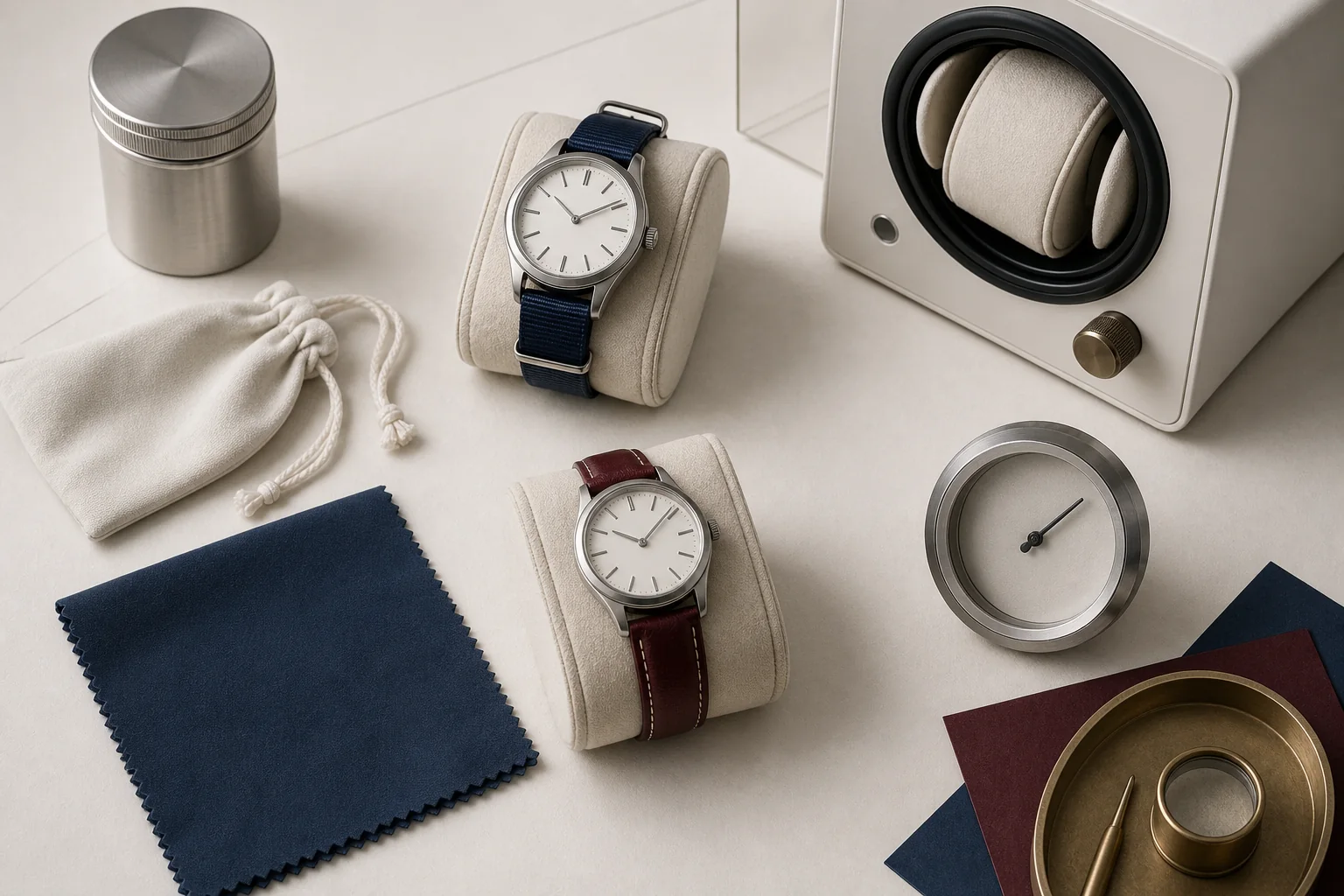
Choose a quiet place
A shelf in a living room is generally a better choice than a bathroom, a sunny windowsill or a car left in the heat. Dry conditions and a stable temperature suit watches; the model’s manual gives its specific limits.
Understanding automatic winding and starting by hand removes much of the worry about a break from wearing a watch. Choose a place away from magnets and keep an eye out for changes that suggest a service visit.
Wipe sweat and moisture off the case before putting it away. Let a leather strap dry naturally. Even a handsome storage case should stay open while the watch inside is damp.
Give the watch a comfortable resting place
A soft compartment of its own keeps a case away from jewellery and other watches. A bracelet brings another small detail: its clasp and links can rub against the case back. A piece of cloth between them helps prevent marks.
A cushion should fit without forcing the bracelet around it. In a travel case, secure support matters too; the watch should not move freely as the case is carried.
Check its neighbours
A loudspeaker, magnetic charger or bag clasp makes a poor neighbour for a mechanical movement. Magnetic resistance varies between calibres, and giving the watch a separate space is usually straightforward.
Keep perfume and household chemicals elsewhere too. They can affect straps, finishes and seals. Watch care does not call for the products used to clean the house.
Is it all right to let it stop?
A movement stops when its power reserve runs out; that is part of its design. A simple mechanical watch generally does not need to run continuously in storage. Start and set it according to the instructions when you want to wear it again.
During a pause of several months, an occasional look at the case and strap can reveal moisture, corrosion or other changes. Servicing still follows the manufacturer’s guidance and the watch’s condition, rather than a homemade winding schedule.
What a winder is for
A winder turns an automatic watch so that its rotor can replenish the mainspring. This is particularly convenient with a complicated calendar: resetting all its displays after a stop can be time-consuming.
For a straightforward three-hand watch, it depends on how much you value immediate readiness. A winder cannot wind a manual calibre or repair a faulty automatic system. It keeps the movement working, so fear of allowing it to stop is not a useful reason to buy one.
If you decide to use one
Match the direction and turns per day to the exact calibre. Use an appropriate programme with pauses; the most intensive setting is not automatically the best.
Secure the watch without stretching the bracelet. If a correct programme fails to maintain its wind, check both the watch and the winder. For storing a simple model, a well-fitting ordinary case may be all you need.
Sources
Technical and historical facts were checked against material from manufacturers, museums and specialist organisations. Read more in How we prepare articles.