

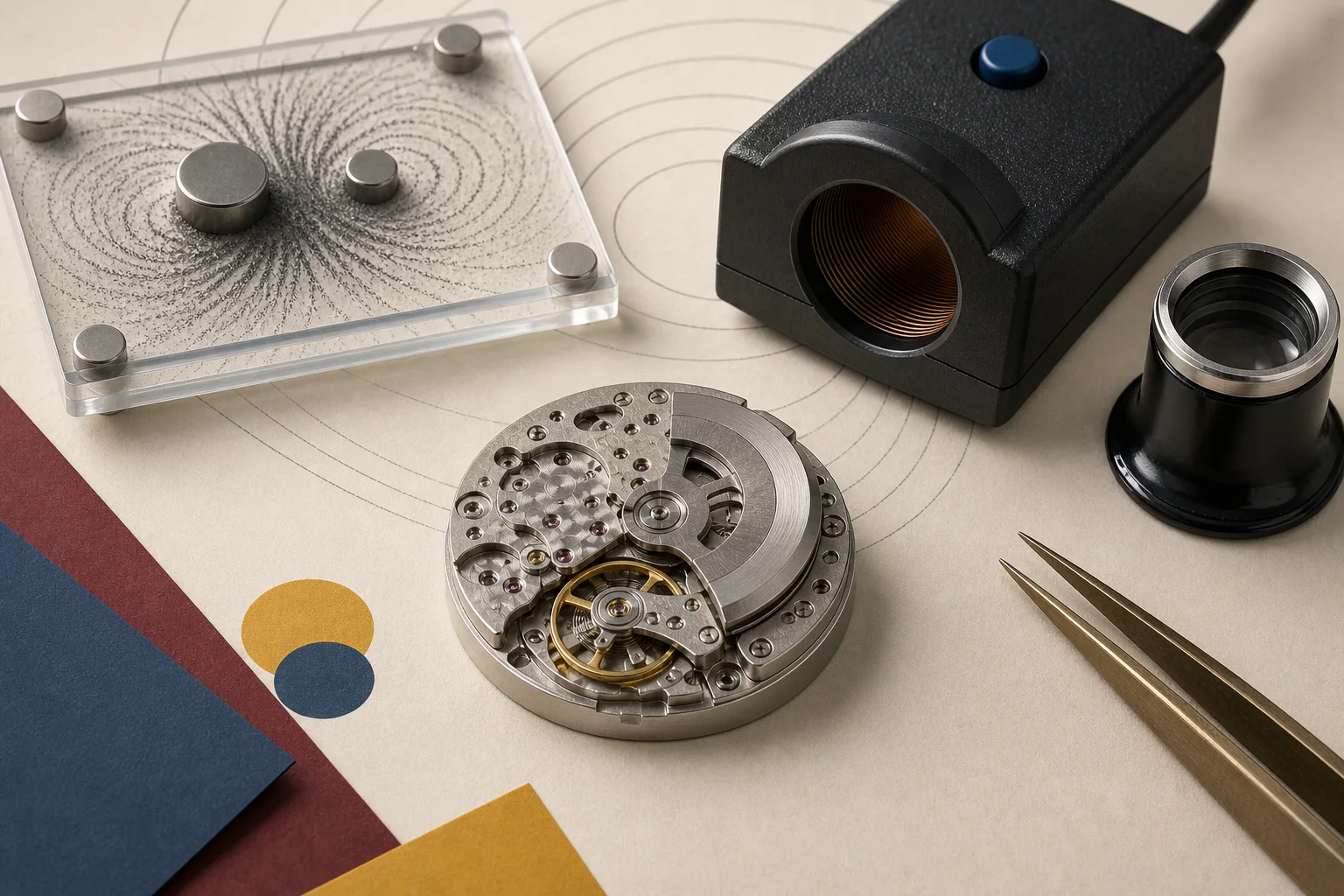
What happens to the hairspring
The balance’s fine hairspring needs to expand and contract freely. If magnetically susceptible coils begin interacting with one another, the spring’s effective length and rhythm can change.
When observing the daily rate, it helps to know your calibre and its normal habits, including whether it has been adequately wound. That gives a watchmaker a clearer account without jumping to a cause.
Other components may respond to the field too. Modern alloys and silicon parts help reduce sensitivity, but the finished watch’s resistance depends on its entire construction.
The source may be nearby
A phone speaker, tablet cover, bag clasp or magnetic charger can look like an innocent neighbour. A sufficiently strong exposure can cause trouble, particularly at very close range.
Seiko gives a guide distance of about five centimetres from ordinary magnetic objects. That should not be extended to powerful magnets. At home, an easy habit is to give watches their own resting place away from equipment containing magnetic parts.
A symptom is not a diagnosis
A mechanical watch may gain or lose time and continue doing so after leaving the source. In an analogue quartz watch, a field can affect the motor and disrupt the display; digital watches without a motor behave differently.
A sudden error does not prove magnetisation. An impact or movement fault can look similar, so the circumstances and actual rate are worth recording before deciding on a remedy.
Why an app is not enough
A phone magnetometer measures the field around the phone. The handset, case, orientation and surrounding objects all affect its readings; it does not directly reveal the condition of a tiny hairspring.
A workshop can test the watch and demagnetise it with appropriate equipment if needed. Timekeeping is checked afterwards, and investigation continues if the problem remains. A powerful household magnet cannot simply reverse the exposure.
What magnetic resistance means
ISO 764 covers magnetic-resistant watches, while separate programmes set higher requirements. METAS, for example, includes exposure to 15,000 gauss when testing Master Chronometer watches. These specifications matter as confirmed test results for particular watches.
The everyday habit is simpler: keep watches away from magnetic objects. After professional demagnetisation, a few days of observation help confirm that the familiar rhythm has returned.
Sources
Technical and historical facts were checked against material from manufacturers, museums and specialist organisations. Read more in How we prepare articles.