

Take the watch off first
The crown connects to the movement through a slender stem. With the case still on your wrist, your fingers can pull at an angle. Holding the watch off the wrist makes it easier to wind straight, without unnecessary sideways load.
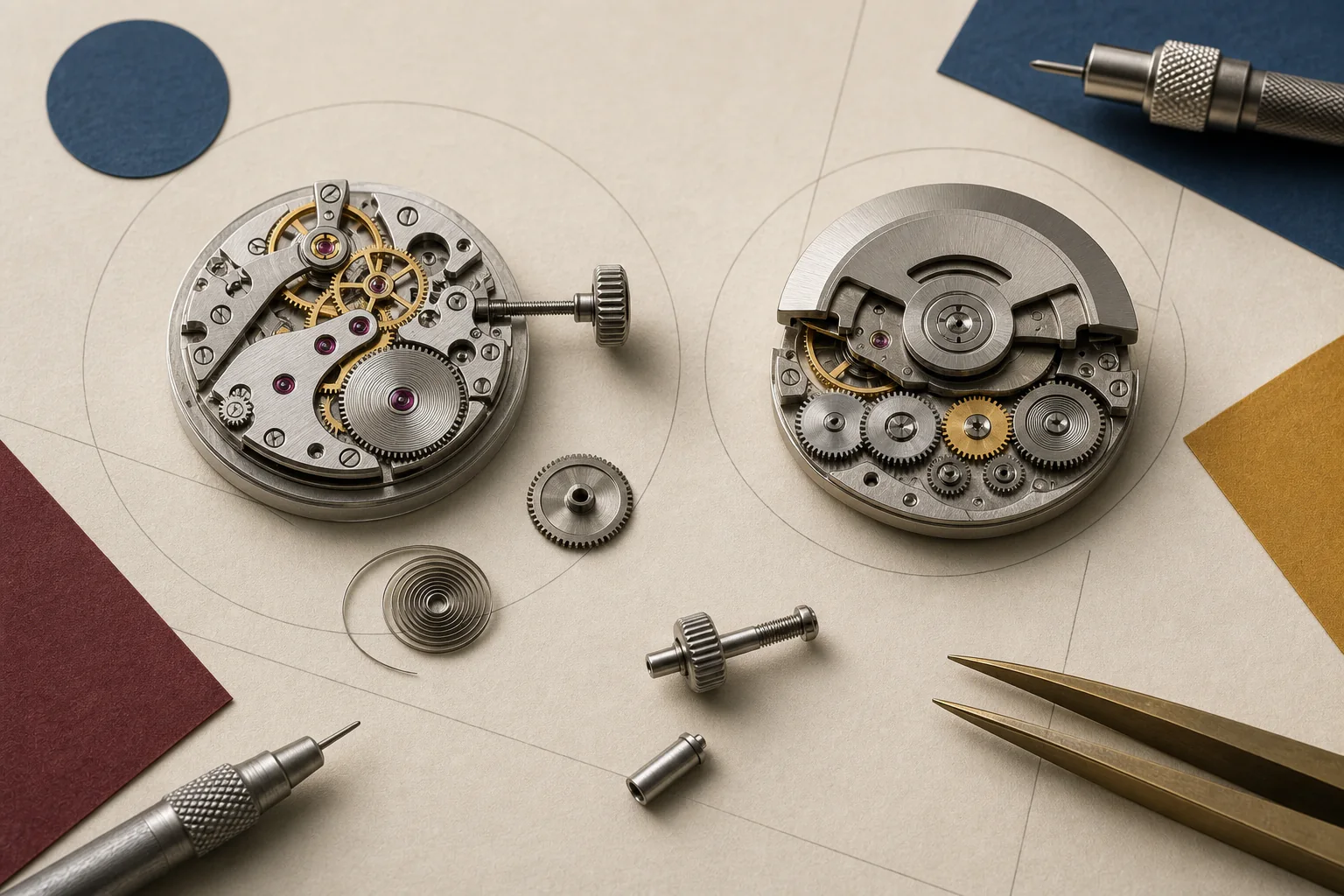
In an automatic watch, the rotor joins in this work, while stored energy determines the power reserve. After a stop, winding is followed by setting the calendar, another small routine with its own rules.
The winding wheels transmit the motion to the mainspring. Quiet clicks accompany the mechanism that prevents the winding train turning back. That is a familiar healthy sound, provided it has not changed to grinding or binding.
Manual winding has an endpoint
Follow the instructions and turn the crown smoothly in the winding direction with short finger movements. Resistance usually increases as the spring winds. A clear final stop means stop, unless the manual describes a special arrangement.
The number of turns depends on the calibre and its remaining energy. “Always give it forty” is not a useful universal rule; learning how your own watch normally feels is more helpful.
An automatic feels different
Many automatic movements support hand-winding. This is useful after a stop: give the spring some initial energy, then set and wear the watch. Check that the feature exists, because some automatics do without it.
In a typical automatic barrel, the mainspring’s outer end slips when fully wound, so there is usually no hard endpoint. Do not keep turning in search of one; use the instructions for an adequate starting wind.
Give the threads some care
Release a screw-down crown from its threads before winding, without pulling forcibly. After winding and setting, press and screw it closed carefully as the model requires. The first turns should engage easily.
If it feels stiff immediately, stop and gently start again: the threads may be crossed. Extra force can turn a simple closure into a repair rather than making it more secure.
Find a place for it in your day
A manual watch lends itself to winding at roughly the same time, perhaps just before putting it on each morning. A repeatable routine also helps when observing accuracy. An automatic often receives enough energy through normal wear, though a very quiet day may fall short.
Wind a dry watch with dry hands. Grinding, an abrupt change in resistance or a noticeably reduced reserve calls for service attention. A healthy movement asks for care rather than force.
Sources
Technical and historical facts were checked against material from manufacturers, museums and specialist organisations. Read more in How we prepare articles.