

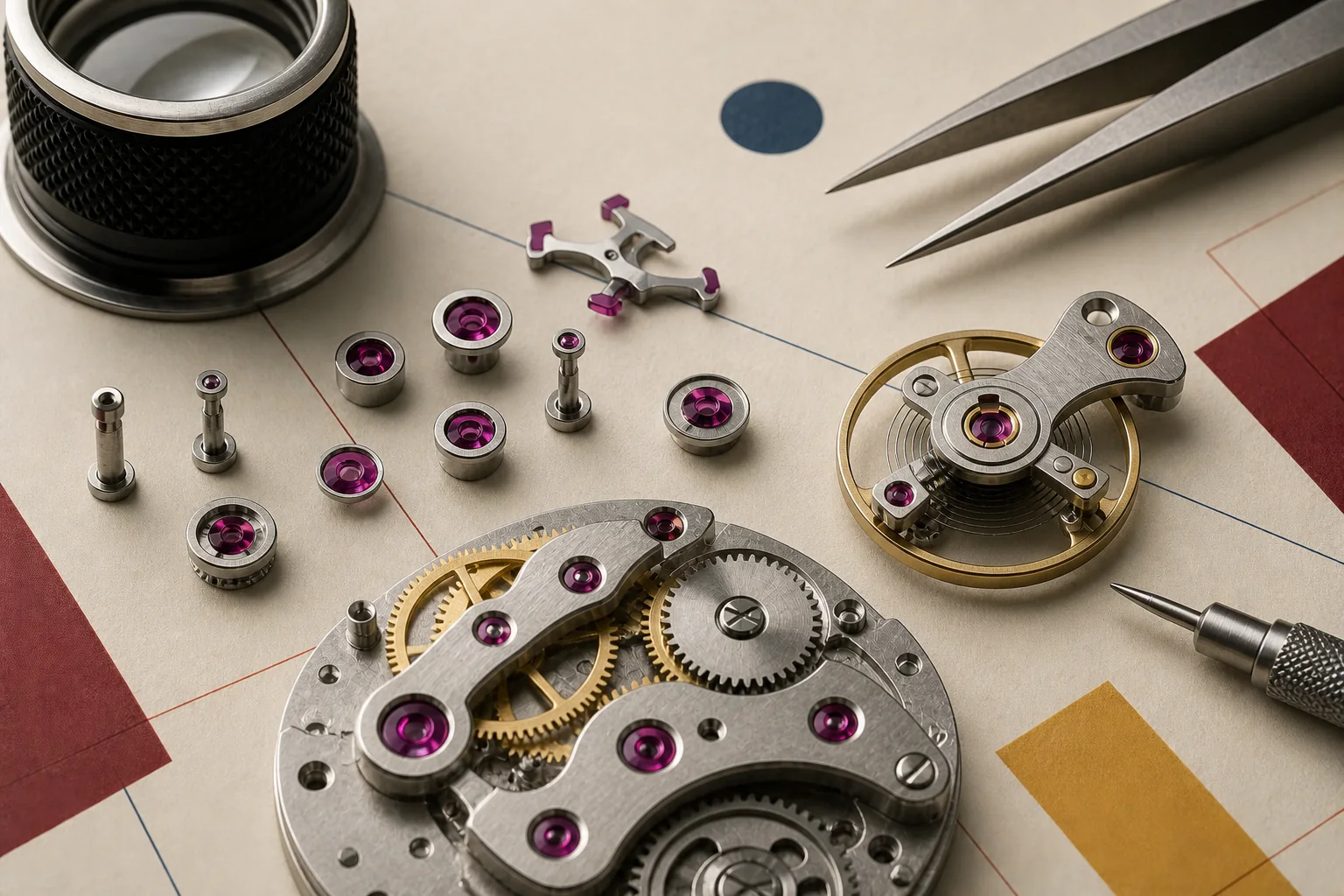
A bearing the size of a dot
A watch-wheel arbor ends in very fine pivots. These rotate in their bearings over and over while the watch runs, needing a smooth surface that keeps its shape.
Each calibre has its own arrangement of these tiny supports. Extra assemblies such as automatic winding may call for more jewels, but their number says less about accuracy than a bridge inscription might suggest.
The hole in a watch jewel provides that support. A polished pivot turns inside it, with a drop of oil held in a designed recess. A tiny component helps countless repeated movements take place with less wear.
Different rubies have different jobs
Some jewels support wheel and balance pivots; others limit movement along the arbor. Ruby pallets on the lever interact with the escape wheel, while a separate impulse jewel helps connect the lever with the balance.
The red dots visible through the back are only part of the arrangement. Others hide beneath bridges or on the dial side, placed according to what the movement needs.
Why watchmakers use synthetic ruby
Watch jewels are made from synthetic ruby. It is hard and consistent, allowing precise shapes and tiny polished holes. Predictable material matters here more than the rarity of a natural gemstone.
Making the part still calls for precision, but a jewel-count inscription does not describe the movement’s jewellery value. These rubies have a different purpose from stones set into a bezel.
Where the count comes from
A manual movement needs one set of bearings, while automatic winding introduces additional assemblies. Extra functions can also change the count. Figures such as 17, 21 and 24 therefore relate primarily to construction.
Seiko’s 4R35 has 23 jewels; the 4R36, which also displays the day of the week, has 24. Another family may arrive at the same total through a different arrangement, making numbers alone a limited comparison.
When enough is enough
Once the necessary points have suitable bearings, adding rubies does not automatically improve accuracy. ISO 1112 even distinguishes functional and non-functional jewels for their designation.
The condition of the pivots, lubrication and adjustment matters much more. Looking through the back, you can simply enjoy the elegance of the solution: tiny stones helping a watch work day after day.
Sources
Technical and historical facts were checked against material from manufacturers, museums and specialist organisations. Read more in How we prepare articles.