

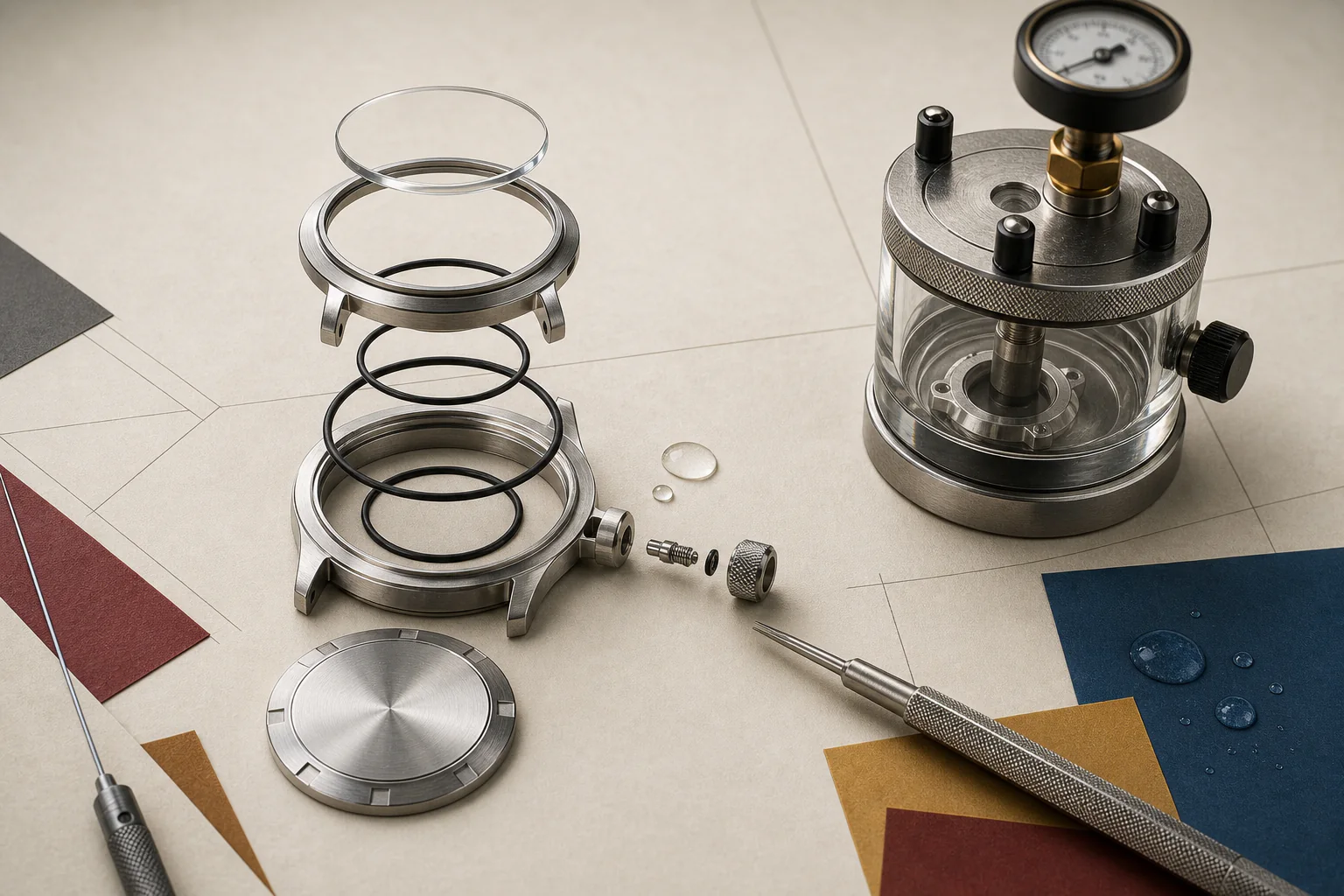
How metres reached the case back
ATM, bar and metres express broadly corresponding pressure levels. About one bar is equivalent to a ten-metre column of water. Tests use controlled conditions; everyday use also involves seal condition, temperature and how the watch is handled.
Living with a watch around water brings other details into focus: the view through its crystal, the way the case fits and how you use the crown to set it. These are the things that become familiar through daily wear.
ISO 22810 covers ordinary water-resistant watches, while ISO 6425 covers divers’ watches. For diving, suitability for that activity matters more than an impressive number on the dial.
Water finds the weak point
The crystal, back, crown and pushers create several joins that must all keep water out. A problem with a single seal can compromise the protection of the whole case.
A screw-down crown helps secure its closure and prevents accidental pulling. Its appearance alone does not establish the rating: well-tested watches can also use an ordinary push-in crown.
From rain to swimming
Three bar is commonly associated with rain and accidental splashes. At five bar, some manufacturers allow swimming while others advise more caution. Ten and twenty bar provide a higher pressure rating, but permitted activities still come from the particular model’s guidance.
This avoids treating a metre figure as your personal diving depth. If water is a regular part of life, choose a watch intended for the activity and find out where its water resistance can be checked.
Protection changes with age
Seals change over time, and an impact to the crown or crystal can disturb a closure. The engraving on the back remains unchanged. Water resistance should be checked after opening, repair or a hard impact.
Workshops have equipment for this purpose. A glass of water at home cannot give the same answer: it exposes the watch to risk without establishing how well the case protects it.
Habits around water
Before permitted water use, close the crown fully. Avoid operating it or ordinary pushers while the watch is wet or submerged unless the manual expressly allows this. A hot shower, sauna or steam room adds heat and steam; an ordinary water-resistance rating should not be treated as permission for them.
After sea use, rinse a swimming-suitable watch in fresh water and dry it as instructed. Mist or droplets inside mean it is time to take it off and contact a service centre promptly. These small habits matter more than confidence in an engraving.
Sources
Technical and historical facts were checked against material from manufacturers, museums and specialist organisations. Read more in How we prepare articles.