

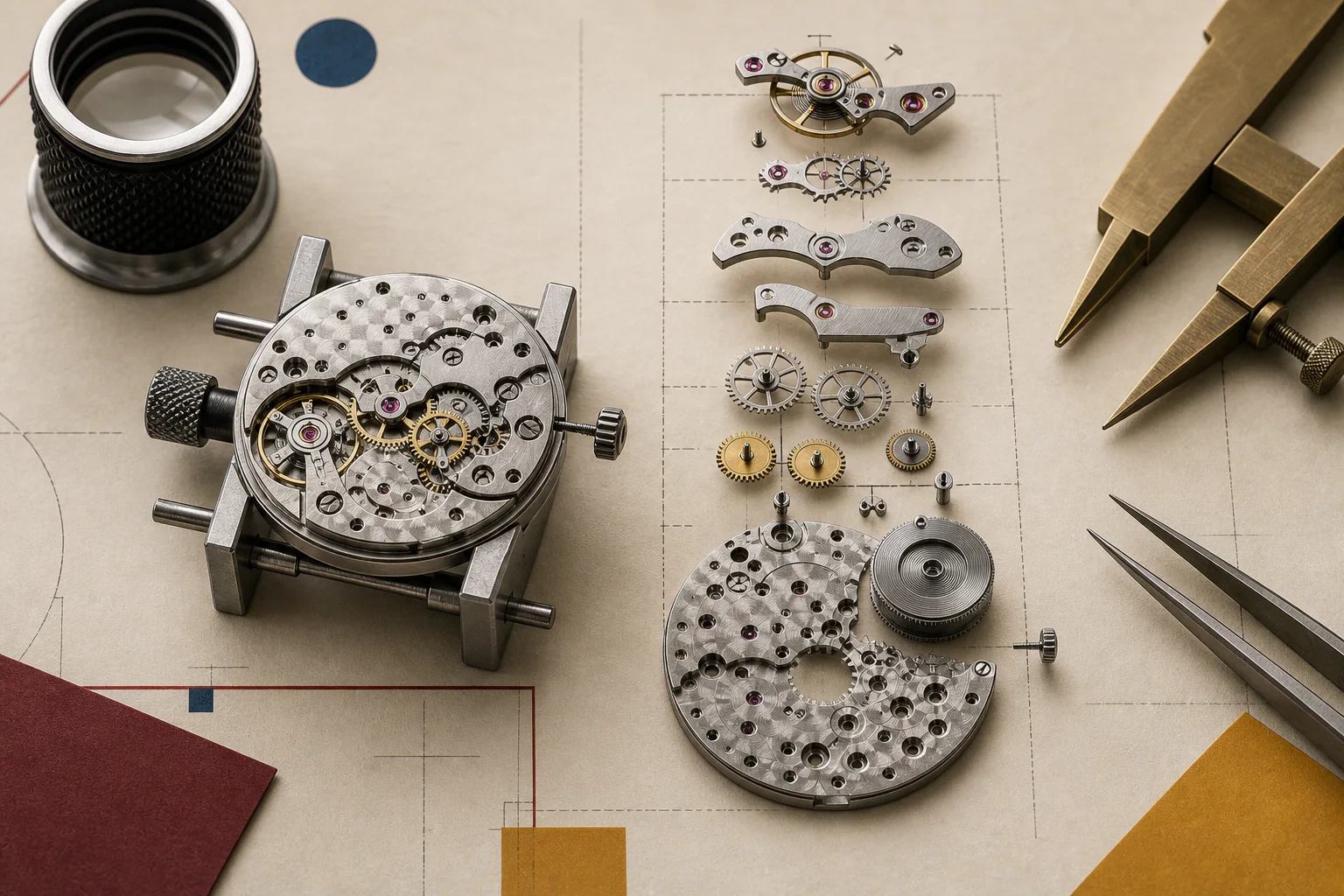
The watch and movement have different names
One calibre can power dozens of models with very different cases and dials. The reverse happens too: an established collection may receive a new movement while keeping its familiar name.
A specification soon introduces jewels and power reserve, each with a straightforward purpose. Familiar codes such as 4R, 6R and NH show how those features come together in real movement families.
Both references are useful when finding instructions or discussing a repair. The watch reference identifies the particular model; the calibre code identifies what is inside.
A small machine built around connections
In a mechanical calibre, a spring stores energy, wheels transmit it and the escapement and balance establish the rhythm. A mainplate and bridges support the assembly. An automatic adds a rotor and gearing to wind the spring through wrist movement.
Similar three-hand displays can conceal different arrangements. Even the choice of central seconds or a small seconds subdial relates to the movement’s construction. A calendar may be built into the base or added as a module.
A family resemblance is not an exact match
A manufacturer can develop versions of one platform with different calendars, reserves and finishes. References distinguish them, but there is no universal code: each company has its own naming logic.
A watch brand may also use an outside movement under its own name or modify it substantially. Finding out what changed is worthwhile; a new designation can reflect anything from decoration to considerable structural work.
Read the specifications through daily use
Translate each feature into an action. Hand-winding lets you start the watch through the crown; stop-seconds helps set it precisely; power reserve describes how long it can rest off the wrist. Frequency explains the rhythm, while the stated tolerance gives an idea of rate variation.
For example, Seiko lists 21,600 vph, around 41 hours of reserve and 23 jewels for the 4R35. Together those figures describe a particular movement, rather than awarding it an overall score.
Think a few years ahead
An unusual in-house design may delight through its construction and finishing. A widely used calibre can be appealing because many watchmakers know it and its service history is well understood. Both have worthwhile qualities.
Find out where the movement can be serviced and whether parts are available. The short code in the description then becomes a useful part of knowing the watch rather than a mystery.
Sources
Technical and historical facts were checked against material from manufacturers, museums and specialist organisations. Read more in How we prepare articles.