

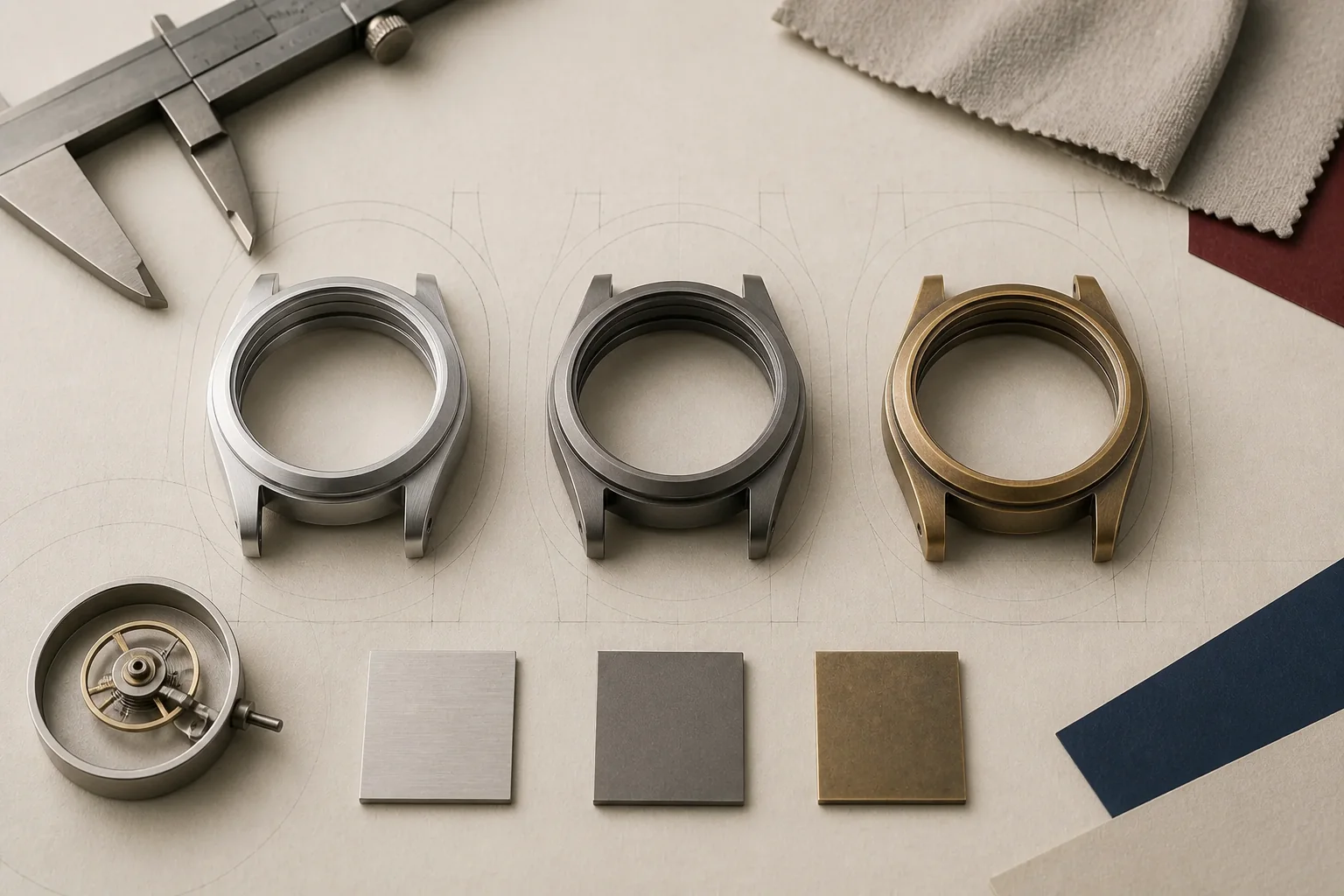
The familiar weight of steel
316L steel is widely used for watch cases. It resists corrosion, takes both polished and brushed finishes well, and has the reassuring weight many people associate with a substantial watch.
On the wrist, the feel of the metal meets case size, while water resistance and the crystal also shape everyday use. These details belong to the broader question of choosing a mechanical watch you will want to wear daily.
“Stainless” does not mean salt and dirt should be left in crevices. Nor should every scratch automatically be polished away: refinishing removes metal, and repeated work can soften the case’s sharp edges.
The lightness of titanium
For an equal volume, titanium is considerably lighter than steel. The difference is especially apparent with a large case and bracelet; by evening, low weight may be more welcome than the heft that impressed you during a first fitting.
Titanium varies too. Grade 2 often appears with a restrained matt finish, while Grade 5 can take a bright polish. The grade, surface treatment and coatings say more about a particular watch than the word “titanium” alone.
How wear becomes visible
A fine scratch catches the light on a mirror finish; on a matt surface, it may appear as a lighter line. The impression of wear depends on the finish as well as the hardness of the material.
Coatings change the picture further. Ordinary polishing can remove a hardened or coloured layer and leave a patch. Before trying to restore a new appearance, find out what refinishing the manufacturer permits.
Bronze keeps changing
The colour of a bronze watch on purchase day is only the beginning. Air, moisture, salt and skin contact gradually create a patina. TUDOR, for example, describes this evolution as a characteristic of its aluminium-copper alloy.
Different bronze alloys behave differently. Patina may develop unevenly or leave marks on skin, and the case back is often made from another metal. Try bronze with its future appearance in mind, rather than expecting showroom brightness to last forever.
Care begins with the finish
Steel, titanium and bronze all need appropriate care for the case and seals. After sea use, where the model permits it, follow its rinsing and drying instructions.
Acids, abrasive pastes and homemade patination methods can affect the finish and other parts of the watch. Allowing bronze to change naturally avoids unnecessary risks to the case.
Finish with a fitting
Put the watch on and feel how its weight is distributed. A low steel case can sometimes sit more securely than a tall titanium one moving on an overly soft strap. Lightness alone does not settle the question of comfort.
If you are sensitive to particular metals, check every component touching your skin, including the back, bracelet and clasp. Then choose the feel you would enjoy for a whole day.
Sources
Technical and historical facts were checked against material from manufacturers, museums and specialist organisations. Read more in How we prepare articles.