
Making sense of the numbers
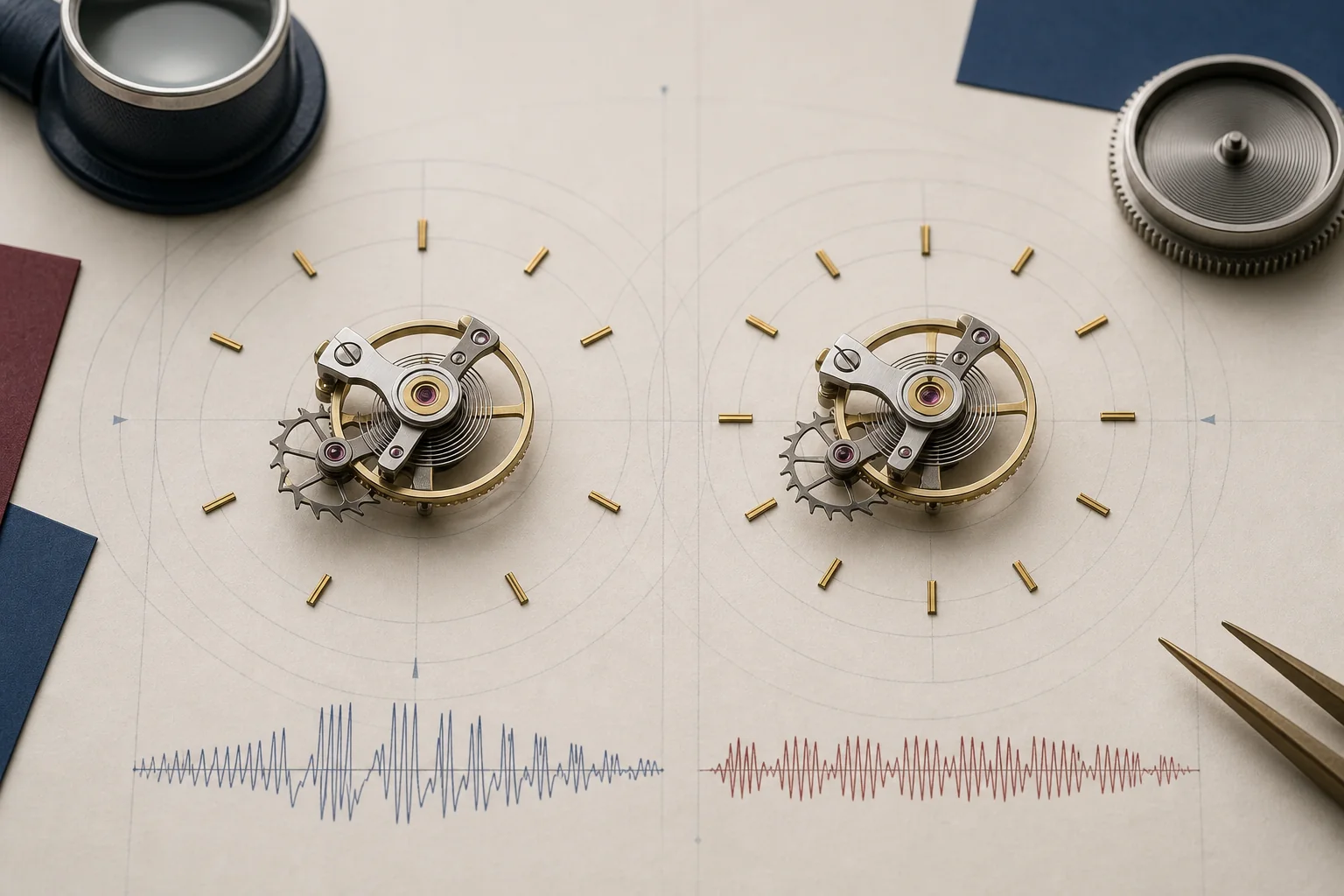
A balance swings one way and then returns. Together those movements make one complete oscillation, but watch specifications often count each half separately. That gives 21,600 vibrations per hour at 3 Hz and 28,800 at 4 Hz.
In a calibre specification, frequency sits alongside accuracy and power reserve. Reading them together reveals the balance of rhythm, energy and performance that the designers were seeking.
On a more familiar scale, that means six and eight escapement steps per second. All else being equal, the second watch advances its seconds hand in smaller, more frequent steps.
A faster rhythm and good timekeeping
Higher frequency interests movement designers because of its potential to cope better with brief disturbances. Realising that potential depends on the balance, hairspring and escapement working together, with sufficient energy from the mainspring.
The number alone promises little. A fast movement still needs precise manufacturing and adjustment; without them, a smooth seconds hand remains a visual pleasure rather than evidence of accuracy.
The work behind each beat
More vibrations mean more escapement interactions each hour. A designer must account for energy use, lubrication and loads on the parts. Solutions range from different materials to changes in the barrel or escapement.
This does not mean a 28,800 vph movement must wear out faster or stop sooner. Consider the finished design, its reserve and its servicing guidance together.
A few real examples
The MIYOTA 8215 combines 21,600 vph with roughly 42 hours of power reserve. At the same frequency, Seiko’s 6R54 offers around 72 hours. That pair alone shows how little frequency says about running time in isolation.
Grand Seiko’s 9S27 operates at 28,800 vph with approximately 50 hours of reserve. These are interesting comparisons provided we remember that they are different designs, rather than one movement simply made to run faster.
What happens on the wrist
Everyday rate is affected by position, temperature, state of wind and the movement’s condition. A carefully adjusted slower calibre can keep better time than a faster one that is poorly adjusted.
Compare the stated tolerance with several days of normal wear. If familiar timekeeping changes abruptly, investigate the watch’s condition rather than the frequency chosen when it was made.
It is fine to choose by eye
A smoother seconds hand is a perfectly understandable reason to prefer 28,800 vph. Part of owning a watch is enjoying the sight of it. Leave room for comfort, reserve, thickness and accessible servicing as well.
Frequency then becomes an interesting quality of a watch you enjoy, rather than a contest between two numbers.
Sources
Technical and historical facts were checked against material from manufacturers, museums and specialist organisations. Read more in How we prepare articles.